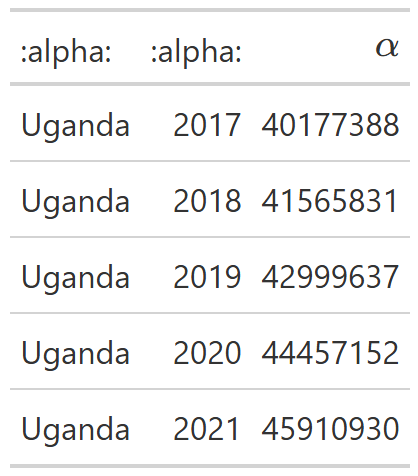
In gt, I'm trying to make a column label which is a Greek letter. The documentation mentions using the notation such as ":alpha:" but I'm not able to get this to work.
library(gt)

tab <- countrypops |>
  dplyr::select(-contains("code")) |>
  dplyr::filter(
    country_name == "Uganda",
    year %in% 2017:2021
  ) |>
  gt() |>
  cols_label(
    country_name = ":alpha:",
    year = md(":alpha:"),
    population = md("$\\alpha$")
  )
This is what I get:
I think this does it, if I understand the problem.
DT1 |> gt() |>
  cols_label(
    country_name= md("$\\alpha$"),
    year = md("$\\beta$"),
    population = md("$\\gamma$")
  )
I'm wondering how to use the syntax provided in the documentation of ":alpha:". I know how to do it with LaTeX.
Greek letters can added by enclosing the letter name in ":"; you can use lowercase letters (e.g., ":beta:", ":sigma:", etc.) and uppercase letters too (e.g., ":Alpha:", ":Zeta:", etc.)
It works for me with "{{:alpha:}}". The double brackets signify the "units definition".
@ kevbaer has it. I just worked it out a few moments ago.
The problem seems to be some rather poorly written text in the manuals. It took me about 4 readings before I realized that :alpha: will only work in a units definition. The manuals are not wrong just obscure.
Yes, thanks. I was trying to RTFM and I just wasn't getting it.